

Most people think owning property in Nigeria is just about having a Certificate of Occupancy. They are mistaken. The C-of-O is a starting point, not the finish line. True ownership is a labyrinth of statutes, consents, and registrations that vary wildly from state to state and even between customary and statutory jurisdictions. Understanding this legal framework isn’t an academic exercise; it’s the only way to ensure the land you paid for is truly yours, secure from future claims or government acquisition.
Property law in Nigeria is a complex structure built upon the foundation of the Land Use Act of 1978. This act vests all land within a state in the governor, who holds it in trust for the people. This means that, technically, no individual has absolute ownership of land, but rather a right of occupancy. Securing this right and legally perfecting the title involves navigating a series of critical legal requirements, including obtaining the governor’s consent for any alienation of interest, paying stamp duties, and registering the instrument of transfer. Failure at any stage can render a transaction voidable or even void, exposing investors to significant financial loss and protracted litigation. As a firm that frequently assists both Nigerian and foreign investors, we’ve seen firsthand how a seemingly minor oversight can jeopardise a major investment.

The Legal Backbone of Nigerian Real Estate
Property law in Nigeria isn’t a single, monolithic entity. It’s a composite of federal statutes, state laws, English common law principles, and local customary laws. This creates a multi-layered system that requires careful navigation. The primary pieces of legislation create the structure within which all property transactions must occur.
The Land Use Act 1978: The Cornerstone
At the heart of modern property law in Nigeria is the Land Use Act of 1978. Before its enactment, land tenure was fragmented, largely under the control of families and communities through customary law. The Act aimed to unify land administration and make land more accessible for development. Its most profound provision, stated in Section 1, is that all land in the territory of each state is vested in the Governor of that State.
This means private ownership was effectively converted to a “right of occupancy.” There are two types:
- Statutory Right of Occupancy: Granted by the State Governor, typically for urban land. It is evidenced by a Certificate of Occupancy (C-of-O).
- Customary Right of Occupancy: Granted by a Local Government Area, typically for rural land. This applies to land used for agricultural, residential, or other purposes within a community.
The Act gives the Governor significant powers, including the authority to grant rights of occupancy and, crucially, the power to revoke them for “overriding public interest.”
Jurisdictional Differences: Not a One-Size-Fits-All System
A critical mistake is assuming the law is uniform across Nigeria. The country inherited different legal systems from its colonial past, leading to distinct property law regimes.
- The Conveyancing Act 1881: This English statute applies to the states of the former Northern and Eastern Regions of Nigeria, except where it has been replaced by local legislation. It governs the transfer of legal title to real property between living persons.
- Property and Conveyancing Law (PCL) 1959: This law, modeled after the English Law of Property Act 1925, applies in the states of the former Western Region (and later Midwest Region). It provides a more modern and comprehensive framework for conveyancing.
- Lagos State Laws: Lagos, as a major economic hub, has its own set of sophisticated property laws, including the Lagos State Real Estate Regulatory Authority Law 2022 and the Lagos State Land Registration Law 2015. These laws introduce specific requirements for registration, transaction processes, and professional conduct.
Types of Land Tenure in Nigeria
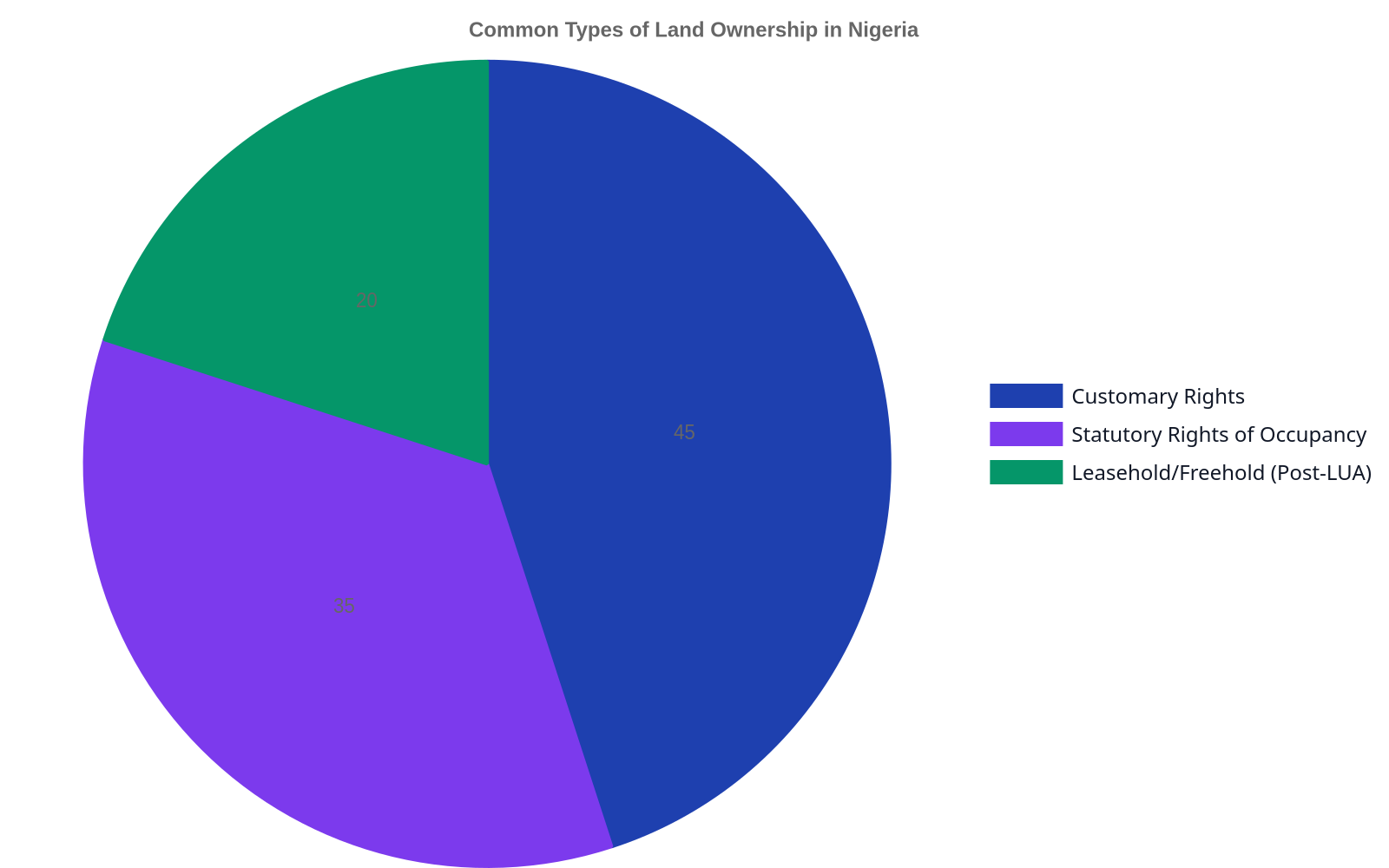

Understanding the way land is held is fundamental to any property transaction. Nigeria operates a dual system where both customary and statutory tenure systems co-exist, often creating complex legal scenarios.
Customary Land Tenure
This is the indigenous system of landholding, rooted in the traditions and customs of local communities. Under this system, land is typically owned by the community, clan, or family, not by an individual in perpetuity. The head of the group (the “Chief” or “Family Head”) manages the land on behalf of the collective. Individuals are granted rights to use portions of this land, but they cannot alienate it (sell, lease, or mortgage it) without the consent of the group’s principal members. While the Land Use Act sought to subordinate this system, customary law remains highly influential, especially in rural areas.
Statutory Land Tenure (Leasehold)
Following the Land Use Act, the dominant form of legal interest one can hold is a leasehold, granted for a specific term, typically 99 years. This is the “Right of Occupancy” discussed earlier. It is a lease from the state government. This applies to land in areas designated as urban by the Governor. For those looking to invest, including the public and private companies we represent, this statutory right is the most secure form of title, provided it is properly documented and perfected.
The Certificate of Occupancy is not ultimate proof of title. It is merely evidence that the state has granted a right of occupancy to the first person on the certificate. A defective root of title can invalidate a C-of-O.
Freehold and Other Interests
True freehold interest, meaning ownership in perpetuity, is now rare in Nigeria due to the Land Use Act. However, interests that existed before 1978 may in some cases be treated as freehold. Other lesser interests in land include:
- Leasehold: A right granted by a holder of a right of occupancy to another person for a term shorter than their own.
- Easements: A right to use another person’s land for a specific purpose (e.g., a right of way).
- Mortgages: A security interest in property to ensure the repayment of a debt.
The Process of Property Acquisition in Nigeria

The process of buying land or property is more than just exchanging money for keys. It is a formal, multi-stage legal process. Skipping a step can be catastrophic.

Step 1: Pre-Contract Investigations (Due Diligence)
Before any money changes hands, a prudent buyer must conduct thorough due diligence. This is the most critical phase. We advise clients to investigate several aspects:
- Title Investigation: A lawyer conducts a search at the relevant Lands Registry to verify the seller’s title. This search reveals the property’s history, the nature of the seller’s interest, and whether there are any encumbrances like mortgages, liens, or pending litigation. In Lagos, this is done at the Lagos State Lands Registry in Alausa.
- Physical Inspection: Visiting the property to check its physical condition, confirm its boundaries, and ensure it corresponds with the description on the title documents. It also helps identify any non-registered issues, like occupier’s rights or boundary disputes.
- Survey Plan Verification: Confirming that the property has a registered survey plan and that the coordinates on the plan correctly “chart” at the Surveyor-General’s office, proving the land is not under government acquisition or committed to a public purpose.
Step 2: The Contract of Sale Stage
Once due diligence is satisfactory, the parties execute a Contract of Sale. This document legally binds the buyer to purchase and the seller to sell the property. It outlines the terms of the sale, including the price, payment plan, and closing date. Typically, the buyer pays a deposit upon signing this contract. The contract itself does not transfer ownership but creates an equitable interest in the property for the buyer.
Step 3: The Conveyance Stage (The Deed)
This is where legal ownership is formally transferred. The seller’s lawyer prepares a deed of assignment, deed of lease, or deed of gift, which is then reviewed by the buyer’s lawyer. This document, once signed by both parties and witnesses, is the instrument that conveys the seller’s interest to the buyer. It is crucial that this deed is drafted correctly to be valid.
Step 4: Perfection of Title
Simply signing a deed isn’t enough. To make the title legally secure and recognized by the state, it must be “perfected.” This is a three-part process.
- Governor’s Consent: Section 22 of the Land Use Act makes it unlawful to alienate a statutory right of occupancy without the prior consent of the State Governor. An application, along with the executed deed and other documents, is submitted to the state’s lands bureau. This is often the most time-consuming and bureaucratic part of the process.
- Stamping: After consent is granted, the deed must be stamped by the Federal Inland Revenue Service (FIRS) or the state’s internal revenue service. The Stamp Duties Act requires this. An unstamped document is not admissible in court as evidence of title.
- Registration: The final step is to register the stamped deed at the state’s Lands Registry. Registration provides a public record of the transaction and secures the buyer’s priority. According to the Land Instrument Registration Act, an unregistered instrument loses priority to a later, registered one.
Common Challenges and Legal Pitfalls
Navigating Nigerian property transactions is fraught with potential dangers. From our experience representing clients, several issues appear repeatedly. These are not just theoretical risks; they are practical problems that can cost millions of Naira.
Defective Title and Fraud
This is the number one risk. A seller may attempt to sell property they do not own, or one with a “defective root of title.” This can happen through forged documents or by selling family land without the consent of all principal family members (the “Omo-Onile” issue in Lagos). A proper legal search is the primary defense against this.
Government Acquisition
Land may be under government acquisition for public purposes (e.g., roads, infrastructure). If a property falls within an acquired area, any private transaction on it is void. Verifying the property’s status at the Surveyor-General’s office is non-negotiable. The government can revoke a Right of Occupancy for “overriding public interest” but must pay compensation as per Section 29 of the Land Use Act.
Failure to Perfect Title
Many buyers, after paying for property and signing a deed, fail to complete the perfection process. This leaves them with only an “equitable” interest, which is vulnerable. A later, more diligent buyer who perfects their title could legally supersede the earlier, unperfected interest. Obtaining Governor’s consent, stamping, and registration are not optional extras.
A transaction that requires Governor’s Consent but proceeds without it is not illegal, but it is ‘inchoate’ or incomplete. The law does not punish the parties, but the transaction is legally ineffective to transfer title until consent is obtained.
Comparison of Land Tenure Systems
| Feature | Customary Tenure | Statutory Tenure (Right of Occupancy) |
|---|---|---|
| Ownership | Held by the community or family. | Right to occupy for a fixed term (e.g., 99 years) from the state. |
| Governing Authority | Family/Community Heads and Customary Law. | State Governor and the Land Use Act. |
| Evidence of Title | Often unwritten; based on tradition and witness testimony. | Certificate of Occupancy (C-of-O). |
| Transferability | Requires consent of family/community principal members. | Requires Governor’s Consent for any alienation. |
| Security | Less secure; prone to disputes and difficult to verify. | More secure; verifiable at a Lands Registry. |
| Use as Collateral | Difficult for formal bank loans due to lack of documentation. | Widely accepted by financial institutions as collateral for mortgages. |

The Role of Mortgages and Tenancy Agreements
Property law extends beyond just buying and selling. It also governs how property is used for financing and leasing, which are critical components of the real estate market.
Mortgages in Nigerian Law
A mortgage is a legal agreement by which a bank, building society, etc., lends money at interest in exchange for taking title of the debtor’s property, with the condition that the conveyance of title becomes void upon the payment of the debt. In Nigeria, the creation of mortgages is also subject to the Land Use Act. Since the highest interest one can hold is a right of occupancy, a mortgage is created by:
- Demise: The borrower grants the lender a lease (or sub-lease) for a term of years, with a provision for it to end upon repayment.
- Legal Charge: This is a statutory creation, particularly under the PCL 1959 and Lagos State laws, where the lender gets a legal charge over the property without any transfer of interest.
Crucially, creating a legal mortgage over a property with a statutory right of occupancy requires the Governor’s Consent. Without it, the mortgage is only an “equitable mortgage,” providing less security to the lender. As a firm that works with both public and private companies, we often structure financing deals where perfecting these security interests is paramount.
Tenancy Law Framework
Tenancy agreements govern the relationship between landlords and tenants. This area is regulated by specific state laws, not federal ones. For example, Lagos has the Tenancy Law of Lagos State 2011. These laws dictate the rights and obligations of both parties, covering issues like:
- Rent Control: Some laws attempt to regulate rent, though this is often ineffective in practice.
- Length of Notice: The law prescribes minimum notice periods for a landlord to terminate a tenancy, based on the rental period (e.g., one week for a weekly tenancy, six months for a yearly tenancy).
- Eviction Process: A landlord cannot forcibly evict a tenant. They must follow a legal process, which involves serving statutory notices (a “Notice to Quit” followed by a “7-Day Owner’s Intention to Recover Possession”) and then obtaining a court order.
Future Trends and Reforms
The landscape of property law in Nigeria is not static. There are ongoing discussions and technological advancements aimed at addressing some of its most persistent challenges.
Digital Land Registries
Several states, led by Lagos, are moving towards digitizing their land registries. The goal of initiatives like the Lagos State e-GIS (Geographic Information System) Is to streamline the search process, reduce fraud, and make land administration more transparent and efficient. A fully digital system would allow for instant verification of titles and encumbrances, drastically cutting down due diligence time. Efficient land registration systems are crucial for economic development, and Nigeria has been working to improve its ranking.
Proposed Reforms to the Land Use Act
For decades, there have been calls to amend or repeal the Land Use Act. Critics argue that vesting all land in state governors creates a bottleneck, encourages corruption in the consent process, and hinders the development of a true mortgage market. Proposed reforms often focus on limiting the governor’s powers, simplifying the consent process, or transitioning to a system of registered freehold titles. However, amending the Act is politically complex as it is embedded in the 1999 Constitution of the Federal Republic of Nigeria (as amended).
FAQ
What is the most important document in a Nigerian property transaction?
The most important document depends on the stage, but the Deed of Assignment (or Conveyance) is arguably the core instrument that transfers title from the seller to the buyer. However, it is only legally potent once it has Governor’s Consent, is stamped, and is registered at the Lands Registry.
Can a foreigner own land in Nigeria?
Yes, a foreigner can own property in Nigeria. However, the Land Use Act requires that any grant of a right of occupancy to a non-Nigerian must be specifically approved by the State Governor. The process is more rigorous, and we have guided many foreign investors through this structured procedure.
What is the difference between a C-of-O and a Governor’s Consent?
A Certificate of Occupancy (C-of-O) is the primary document issued by the state government to the initial holder of a Statutory Right of Occupancy. It is the first title. Governor’s Consent is the approval required for any subsequent transaction on that land, such as selling it, mortgaging it, or leasing it. A C-of-O is issued once, while Governor’s Consent is needed for every transfer thereafter.
What are “Omo-Onile”?
“Omo-Onile” is a Yoruba term meaning “children of the original landowner.” It refers to descendants of the families who held customary ownership of land before the Land Use Act. In areas like Lagos, they are notorious for demanding illegal fees from property buyers and developers, even after the land has been sold, often leading to disputes and disruptions. Dealing with them requires careful legal strategy.
How long does it take to perfect a property title in Nigeria?
The timeline varies significantly by state and the efficiency of the local lands bureau. The process of obtaining Governor’s Consent can take anywhere from a few months to over a year in some states. Stamping and registration are typically faster. A realistic timeframe for the entire perfection process is often between 6 to 18 months.
Investing in Nigerian real estate offers significant opportunities, but the legal complexities cannot be understated. A thorough understanding of the law and diligent adherence to the processes are the only ways to secure your investment. If you are considering a property transaction, engaging a competent legal advisor from the very beginning is not a cost, but an essential protection. Contact Ardnas Legal to ensure your real estate dealings are secure and legally sound.
About the author

Sandra Adeniran
Principal Partner
Adebola Adeniran is the Founding Partner of Ardnas Legal Practitioners. She is a dynamic and forward-thinking lawyer with a passion for providing innovative legal solutions to businesses and individuals. Adebola combines deep legal expertise with a practical, business-oriented approach, ensuring that clients receive advice that is both strategic and actionable.