

Issuing a notice to quit incorrectly can cost you more than just time; a flawed notice can invalidate your entire eviction process, forcing you to start over and potentially leaving you liable for damages. A lawful notice to quit in Lagos is not a mere suggestion for the tenant to leave, but a compulsory, foundational step in the legal process of recovering possession of your property. Without a valid notice that strictly adheres to the Tenancy Law of Lagos State 2011, any subsequent steps, including the 7-day owner’s intention to recover possession, are legally void.
This guide will walk you through the essential criteria for issuing a legally sound notice, ensuring you get it right the first time. We work with both landlords and corporate clients, including public and private companies, and have seen firsthand how minor procedural errors lead to major financial and legal setbacks.
1. Calculating the Correct Notice Period
Why it matters: The most common mistake landlords make is providing an insufficient notice period. The law is not flexible on this. Providing a shorter period than legally required will render the notice invalid, and the court will strike out your case for being premature. The clock for the notice period starts the day after the notice is served on the tenant.
How to check it: The correct notice period is determined by the tenancy agreement. If the agreement is silent on the notice period, the Tenancy Law of Lagos State 2011 provides statutory periods. The default periods are:
- Tenancy at will: 1 week’s notice
- Monthly tenancy: 1 month’s notice
- Quarterly tenancy: 3 months’ notice
- Half-yearly tenancy: 3 months’ notice (note: not 6 months)
- Yearly tenancy: 6 months’ notice
What a good answer looks like: If your tenant pays rent monthly, you must give them one full calendar month of notice. For a yearly tenant who pays a single annual sum, they are entitled to a full six months. Always err on the side of caution; giving a longer notice period is legally acceptable, but a shorter one is fatal to your case.
A notice to quit isn’t a conversation starter. It is a formal legal instrument. Treating it casually is the fastest way to lose in court before the case even begins.
2. Ensuring Proper Service of the Notice
Why it matters: A perfectly written notice is useless if the tenant can plausibly deny ever receiving it. The burden of proof for service lies entirely with the landlord. If you cannot prove the tenant received the notice, legally, it was never served.
How to check it: The best method of service is personal service, where the notice is handed directly to the tenant. If the tenant is unavailable, it can be served on any adult residing at the premises. However, the most defensible method is substituted service. This involves pasting the notice on a conspicuous part of the premises, like the front door, and having a photograph of it as evidence. Using a professional court bailiff or a lawyer to effect service adds a layer of credibility. Our firm has assisted numerous clients, from individual landlords to Nigerian and foreign investors, in documenting this crucial step properly.
What a good answer looks like: The ideal proof of service includes a sworn affidavit from the person who served the notice, detailing the date, time, and method of service. If substituted service was used, photographic evidence should be attached to the affidavit. Simply sending a WhatsApp message or an email is often insufficient unless your tenancy agreement explicitly allows for electronic service, a point highlighted by legal experts at Mondaq.

3. The Content and Wording of the Notice
Why it matters: A notice to quit must be clear, unequivocal, and contain specific information. Any ambiguity can be exploited by the tenant’s counsel to argue the notice is invalid. It cannot be a “provisional” notice or suggest that the tenant can remedy the situation to avoid eviction (that comes earlier, with a notice of breach, if applicable).
How to check it: A valid notice must contain:
- The name of the landlord and tenant.
- A clear and accurate description of the property. This should match the description in the tenancy agreement.
- The date the tenant is required to quit and deliver up possession. This date must align with the end of a tenancy period (e.g., the last day of the month for a monthly tenancy).
- A clear statement of the intention to end the tenancy. Phrasing like “TAKE NOTICE that you are hereby required to quit and deliver up possession…” is standard.
What a good answer looks like: The notice should be drafted by a legal professional. While templates exist, a small error in the property description or the quitting date can derail the process. For example, asking a monthly tenant to leave on the 15th of the month, when their tenancy runs from the 1st to the 31st, invalidates the notice. The notice must expire on the eve of the anniversary of the tenancy.
4. Understanding Who Can Issue the Notice (The Overlooked Criterion)
Why it matters: Many landlords assume they or their caretakers can simply sign and serve a notice. This is a critical error. Under Nigerian law, only the landlord or their duly authorized agent or solicitor can issue a valid notice to quit. A notice signed by an unauthorized party is worthless.
How to check it: Who is a “duly authorized agent”? This is typically someone with a formal letter of authority or power of attorney from the landlord. A caretaker or property manager may not automatically have this legal authority unless it is explicitly granted in writing. The safest route is to have your legal practitioner issue and sign the notice on their letterhead. This removes all doubt about authority.
What a good answer looks like: A notice signed by “Sandra Adeniran, Solicitor for [Landlord’s Name]” is unequivocal. If an agent signs, they should state it clearly: “[Agent’s Name], for and on behalf of [Landlord’s Name], by a letter of authority dated [Date]”. The lack of this clear line of authority is a common, and completely avoidable, reason for eviction cases to fail.
Many landlords focus on the tenant’s breaches but lose their case based on their own procedural mistakes. The law protects tenants from arbitrary eviction, and courts enforce these protections strictly.
5. Post-Notice Actions: The Waiting Game and Next Steps
Why it matters: After a valid notice to quit expires, the tenancy is legally terminated. However, if the tenant remains in possession, you cannot resort to self-help, like changing the locks or throwing their property out. Doing so is illegal and can expose you to a lawsuit for forcible entry and damages. There is a legal process to follow.
How to check it: Once the notice to quit expires and the tenant has not vacated, the next step is to issue a “7 Days’ Notice of Owner’s Intention to Apply to Court to Recover Possession.” This is a separate, mandatory notice. It informs the tenant that if they do not leave within 7 days, you will commence legal proceedings against them.
What a good answer looks like: Only after the 7 Days’ Notice expires can you file a claim for recovery of premises at the appropriate Magistrate or High Court. The court will then issue a summons to the tenant, and the legal process of eviction formally begins. Adhering to this two-step notice process is non-negotiable for a lawful eviction in Lagos.

Questions to Ask Before You Commit
Before you instruct a solicitor or decide to draft a notice yourself, here are key questions to answer:
- What is the exact type of tenancy (monthly, yearly, etc.)?
- Does my tenancy agreement specify a notice period? If so, what is it?
- When does the current tenancy period end?
- Do I have clear proof of the tenant’s last payment to establish the tenancy cycle?
- Is the property address in the agreement clear and unambiguous?
- Who will sign the notice? Do they have written authority if they aren’t me or my solicitor?
- How will we serve the notice and document it?
- Do we have a reliable witness or photographer for substituted service?
- What is my plan if the tenant ignores the notice to quit?
- Have I accounted for the additional 7 Days’ Notice after the first one expires?
- Do I have a budget for the legal fees required for the court process?
- Is the reason for eviction a breach of covenant that I can prove in court?
Red Flags in the Eviction Process
Be wary of advice or actions that include these red flags. They will likely harm your case.
- Relying on “Quit Notice by SMS”: Unless your contract specifically allows it and you can prove receipt, this is highly unreliable and easily challenged.
- Using the Police to Intimidate: The police have no authority in civil tenancy matters. Their involvement is illegal and can lead to a counterclaim against you.
- Changing the Locks or Cutting Utilities: This is a criminal offense under the Tenancy Law of Lagos State. Section 44 of the law specifies that any landlord who does this is liable on conviction to a fine or imprisonment.
Accepting Rent After Notice Expires: If you accept rent for a period after* the notice to quit has expired, you may have inadvertently created a new tenancy, waiving the notice you just served. It is crucial to only accept payments for arrears up to the notice expiry date, and to clearly label them as such.
A Decision Framework for Landlords
To ensure your eviction process is sound, use this simple scorecard:
- If your primary concern is speed: Your only path is strict legal compliance. Any shortcut will cause delays. The fastest method is the legally correct one, executed by a professional.
- If your primary concern is cost: The cost of a failed eviction (repeated legal fees, lost rent) is far higher than the cost of getting professional help upfront. Weigh the N100,000-N250,000 in potential initial legal fees against 6-12 months of lost rent and repeated court filing costs. Ardnas Legal is known for providing cost-effective and well-timed solutions for this very reason.
- If the tenant is contentious: Do not engage directly. Let all communication and notices flow through your solicitor. This creates a formal record and prevents emotional confrontations that can complicate the legal case.
Ultimately, for yearly tenancies or situations involving significant rent arrears, professional legal oversight (Criteria 3, 4, and 5) should be weighted heaviest. For a simple, undisputed monthly tenancy, getting the notice period and service right (Criteria 1 and 2) is paramount.
FAQ
What happens if I make a mistake on the notice to quit in Lagos?
If there is a mistake, such as an incorrect notice period or a wrong property description, the notice is considered invalid. A tenant’s lawyer can get your eviction lawsuit dismissed on this technicality, and you will have to start the entire process over by issuing a new, correct notice.
Can I evict a tenant for any reason?
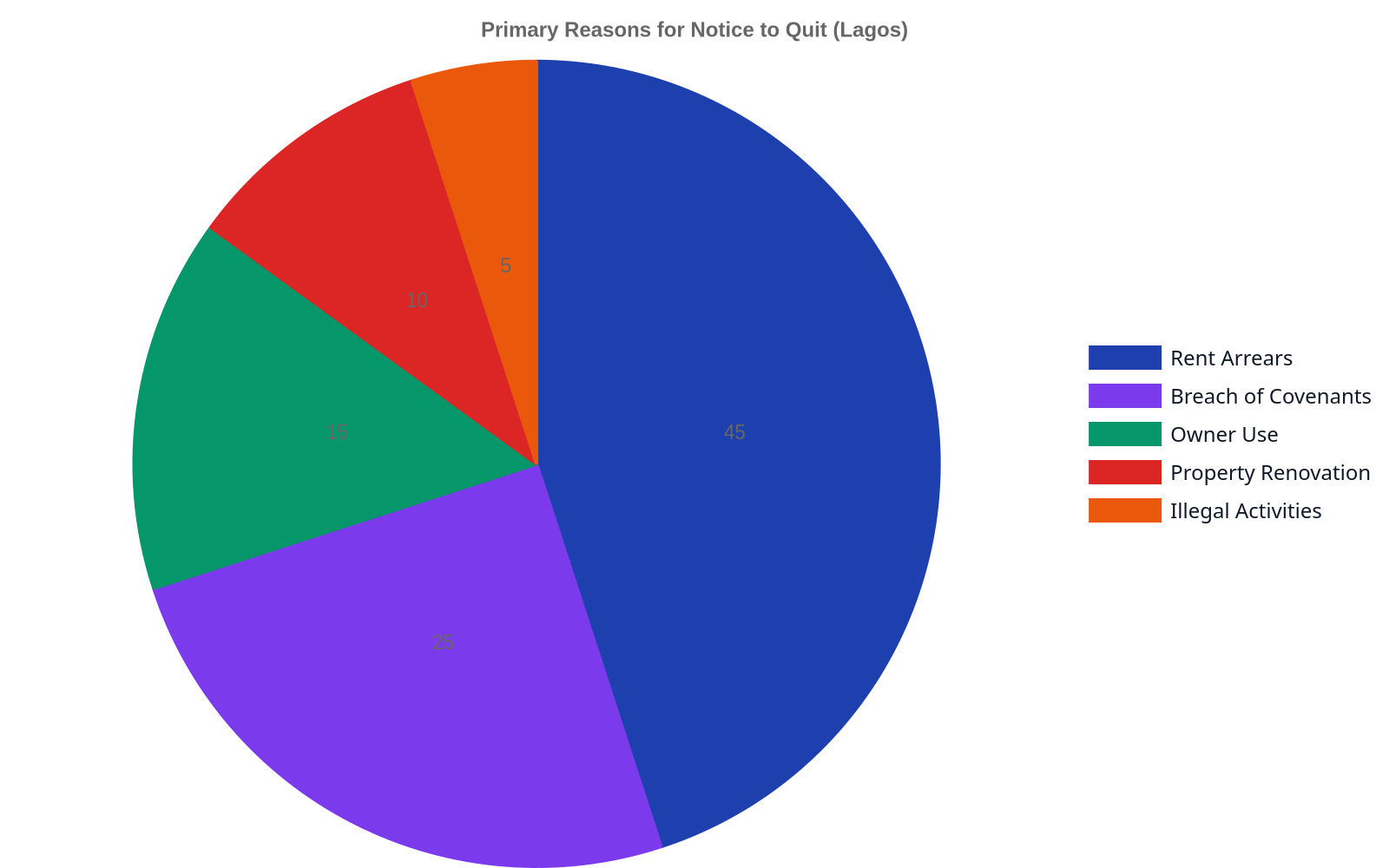
No, you cannot. A landlord must have a valid reason, such as non-payment of rent, breach of a covenant in the tenancy agreement (e.g., subletting without permission), or requiring the property for personal use. The notice does not need to state the reason, but you will need to prove it in court if the tenant challenges the eviction.
How long does the court process take after the notices expire?
This can vary significantly depending on the court’s schedule, the complexity of the case, and any delaying tactics used by the tenant. In Lagos, it can take anywhere from 3 to 18 months to get a judgment and a warrant of possession from the court. The Nigerian court system faces a significant backlog, a fact well-documented by legal analysts like the Carnegie Endowment for International Peace.
What is the difference between a notice to quit and a 7-day notice?
A Notice to Quit is the first formal notice that terminates the tenancy agreement at the end of a tenancy period. The 7 Days’ Notice of Owner’s Intention to Recover Possession is the second notice, issued after the first one expires, warning the tenant of impending court action. Both are required for a lawful eviction in Lagos.
Can a tenancy agreement waive the need for a notice to quit?
Generally, no. While parties can agree to a specific length of notice in their agreement, they cannot completely waive the requirement for a notice to quit. The statutory protections afforded to tenants cannot be contracted out of, especially in residential tenancies governed by the Lagos State Tenancy Law 2011.
Does this process apply to commercial properties as well?
Yes, the procedure for issuing a notice to quit and recovering possession is largely the same for both residential and commercial properties in Lagos. The key differences might arise from the specific terms negotiated in the commercial lease agreement, but the foundational legal requirements of the Tenancy Law still apply to most properties in Lagos.
Navigating the legal requirements for a notice to quit in Lagos demands precision and a thorough understanding of the law. A single misstep can compromise your position and lead to frustrating delays. If you are a landlord or property investor facing the prospect of eviction, ensure your actions are legally sound from the very first step. Contact Ardnas Legal today for a consultation to protect your property and your rights.
Related reading
About the author

Sandra Adeniran
Principal Partner
Adebola Adeniran is the Founding Partner of Ardnas Legal Practitioners. She is a dynamic and forward-thinking lawyer with a passion for providing innovative legal solutions to businesses and individuals. Adebola combines deep legal expertise with a practical, business-oriented approach, ensuring that clients receive advice that is both strategic and actionable.