

Many foreign investors assume registering a company in Nigeria is a monolithic, red-tape-filled nightmare. The reality is more nuanced. Successful foreign company registration in Nigeria requires understanding the specific steps and legal frameworks, primarily the Companies and Allied Matters Act (CAMA) 2020. The process involves registering with the Corporate Affairs Commission (CAC) and securing permits from the Nigerian Investment Promotion Commission (NIPC). Key steps include a name reservation, appointing directors, defining share capital, and filing requisite documents, all leading to post-registration compliance like obtaining a business permit and expatriate quota.
This guide provides a step-by-step breakdown based on our experience assisting foreign investors, from public and private companies to international consultancy firms. We will outline the exact requirements, potential pitfalls, and specific regulatory bodies you will interact with. This isn’t abstract legal theory; it’s a field guide for market entry.

Our Methodology
This guide is not a simple checklist. We have structured this process chronologically, from pre-registration considerations to post-incorporation compliance. The steps are sequenced based on the critical path required by Nigerian law and the practical realities of interacting with agencies like the CAC and NIPC. Each item is detailed with its specific legal basis under CAMA 2020, required documentation, and common challenges we’ve observed in our practice. We also include a comparison of different business structures to help you make an informed decision from the outset.
1. Choosing the Right Business Structure
The first critical decision is the type of entity you will establish. For most foreign entities aiming to do business in Nigeria (as opposed to with Nigeria), the law mandates local incorporation. You cannot simply open a branch of a foreign company and expect to operate indefinitely, with few exceptions.
Under Section 78 of the Companies and Allied Matters Act (CAMA) 2020, foreign companies intending to carry on business in Nigeria must be incorporated as a separate, local entity. The most common and recommended structure for foreign investors is the Private Limited Liability Company (LTD). It offers protection by limiting the liability of the shareholders to the amount of capital they have invested. As we advise many Nigerian and foreign investors, this structure provides a clear and legally sound foundation for operations.
- Best for: Foreign parent companies seeking a long-term presence in Nigeria while protecting the parent entity from the liabilities of the Nigerian subsidiary.
- Watch out for: The minimum share capital requirements. While the general minimum is ₦100,000, for companies with any foreign ownership, the requirement is ₦10,000,000 (ten million Naira). Certain regulated industries have even higher thresholds.
2. Name Availability Search and Reservation
Before you can draft any incorporation documents, you need a name. This step is managed through the Corporate Affairs Commission (CAC) online portal. You can submit up to two proposed names for your new company. The CAC will check them against the existing database of registered companies, business names, and incorporated trustees.
Your proposed name will be rejected if it is identical or too similar to an existing name, if it’s a restricted name that requires special consent (like “Federal,” “National,” “Government,” “Municipal,” or “Chamber of Commerce”), or if it’s deemed undesirable or offensive. Once a name is approved, it is reserved for you for 60 days. This gives you a window to assemble all the other required information and documents for the full registration application. It’s a seemingly simple step, but a crucial gatekeeper for the entire process. We often guide foreign law firms on this point when they assist their clients in entering the Nigerian market.
- Best for: Securing your brand identity early and preventing delays later in the registration process.
- Watch out for: Generic or descriptive names that are likely to be rejected. Be creative but professional. Avoid names that imply a connection to government or operate in a regulated sector unless you are prepared to meet the requirements for consent.
3. Appointing Directors and a Company Secretary
Every Nigerian company must have at least two directors. For a private company, there’s no requirement for any of the directors to be Nigerian citizens. However, from a practical standpoint, having a resident director can simplify banking and administrative matters. Directors must be at least 18 years old, of sound mind, and not be disqualified under the provisions of CAMA.
A common pitfall for foreign investors is overlooking the mandatory appointment of a Company Secretary. Under the older CAMA 1990, all companies needed one. CAMA 2020 relaxed this for small companies, but it remains mandatory for public companies and, critically, for all companies with foreign shareholders.
The Company Secretary, who must be a legal practitioner, chartered accountant, or similar professional body member in Nigeria, ensures corporate governance and compliance. Their role is not merely administrative; they are a key officer of the company responsible for advising the board on legal and regulatory matters. This is a non-negotiable requirement for foreign-owned entities.
- Best for: Establishing a clear governance structure from day one and ensuring compliance with Nigerian corporate law.
- Watch out for: The assumption that a Company Secretary is optional. For any entity with foreign participation, it is a mandatory appointment. Failing to appoint a qualified secretary will halt your registration.
4. Preparing Registration Documents
With a name reserved and officers appointed, the next stage is to compile the core constitutional and informational documents for the company. These are filed with the CAC as part of the formal application for incorporation. The process is now largely electronic via the CAC portal, but the documents must be meticulously prepared.
Key documents include:
- Memorandum and Articles of Association (MemArt): This is the company’s constitution. The CAC provides a standard template that can be adopted, but for businesses with specific governance needs, a custom MemArt drafted by a legal professional is advisable.
- Particulars of Directors and Shareholders: This includes full names, addresses, nationalities, dates of birth, and means of identification (e.g., passport data page for foreigners).
- Statement of Share Capital: This document details the total authorized share capital (at least ₦10 million for foreign-owned companies), the division of shares, and the initial share subscribers.
- Address of the Registered Office in Nigeria: You must have a physical address in Nigeria at the time of registration. A lawyer’s or accountant’s office can often be used for this purpose initially.
- Best for: Creating a legally sound corporate structure that reflects the intentions of the shareholders and directors.
- Watch out for: Errors or inconsistencies in the submitted documents. Any discrepancies between names, addresses, or share allotments can lead to queries from the CAC and significant delays. According to research from SMU’s law journal, precision in these founding documents has been a cornerstone of corporate law for decades, echoing principles from as far back as 1971.

5. Filing with the CAC and Paying Stamp Duty
Once all documents are prepared and uploaded to the CAC’s online portal, the next step is payment. This involves two separate payments: the CAC’s filing fees and the Stamp Duty. Stamp Duty is a federal tax levied by the Federal Inland Revenue Service (FIRS) on the value of the company’s share capital.
The CAC portal has an integrated system for paying the stamp duty directly to the FIRS. The duty is calculated as 0.75% of the authorized share capital. For a company with the minimum ₦10,000,000 share capital for foreign participation, this amounts to ₦75,000. The CAC filing fees are separate and depend on the share capital amount. Once both payments are confirmed, the CAC reviews the application. If everything is in order, the Commission will issue an electronic Certificate of Incorporation, a Status Report, and the certified Memorandum and Articles of Association.
- Best for: Formalizing the company’s legal existence in Nigeria.
- Watch out for: Assuming the filing fee is the only cost. Stamp Duty is a significant, separate expense that must be paid before the CAC will process the incorporation. Budget for both.
6. Post-Incorporation Registration with NIPC
Incorporating with the CAC makes your company a legal entity, but it does not automatically grant you the right to do business as a foreign-owned enterprise. For that, you must register with the Nigerian Investment Promotion Commission (NIPC). This is a mandatory step under the NIPC Act.
The NIPC is the federal agency responsible for encouraging, promoting, and coordinating foreign investment in Nigeria. Its registration process is handled through its One-Stop Investment Centre (OSIC), which brings together officials from various government agencies to simplify business entry. To register, you will need to submit your CAC incorporation documents and a completed NIPC Form 1. Upon successful registration, the NIPC issues a Business Permit, which formally authorizes the company to operate in Nigeria. This permit is a life-long permit for the company.
- Best for: Gaining the official federal government authorization required for a foreign-owned company to legally commence operations.
- Watch out for: The misconception that CAC registration is the final step. Without a NIPC Business Permit, your foreign-owned company is not fully compliant and cannot legally operate.
7. Securing Expatriate Quota and Visas
If your new company intends to employ non-Nigerians, you must apply for an Expatriate Quota from the Federal Ministry of Interior. The Expatriate Quota is a permit that allows a company to employ expatriates for specifically approved job designations. It also forms the basis for the employees’ residence and work permits (known as CERPAC – Combined Expatriate Residence Permit and Aliens Card).
Don’t assume an Expatriate Quota is granted automatically. You must justify the need for each expatriate position by demonstrating that there are no qualified Nigerians available to fill the role.
The application requires submitting your incorporation and NIPC documents, a detailed business plan, and justifications for each requested expatriate slot. The Ministry of Interior scrutinizes these applications carefully. A common challenge arises when companies request a large number of quota positions without sufficient justification or a clear plan for knowledge transfer to local staff. Successful businesses, including many public and private companies, build their requests around specific, high-skill roles.
- Best for: Legally employing foreign nationals in your Nigerian company and ensuring they can obtain the necessary work and residence permits.
- Watch out for: A weak or poorly justified application. The process can be lengthy, and rejections are common if the business case is not compelling. A recent article highlighted the continued importance of these regulations in the “2026 Guidelines“.
Costs Associated with Foreign Company Registration
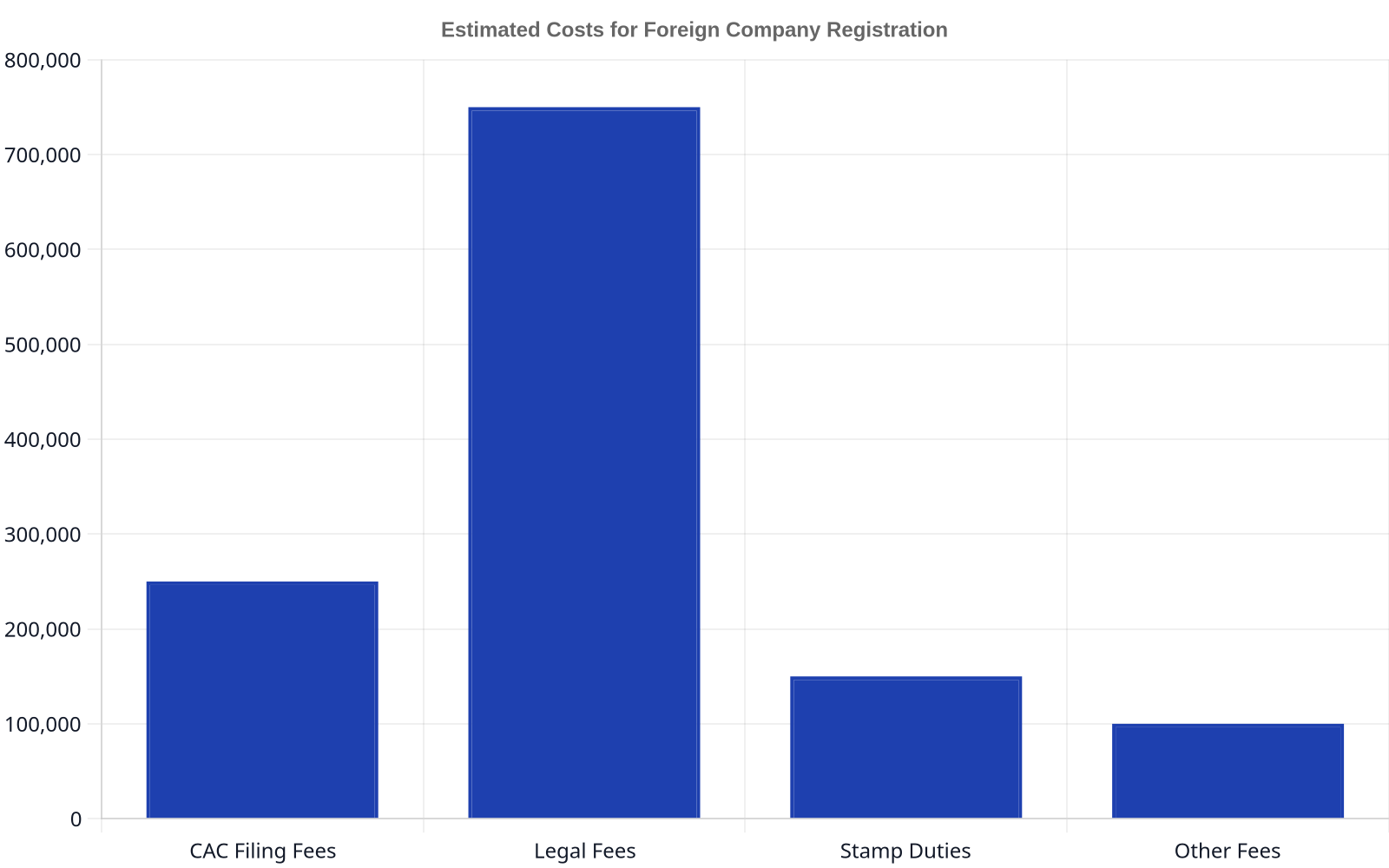
Budgeting accurately for registration is crucial. While legal fees will vary, the statutory costs are relatively fixed. Below is a breakdown of the primary expenses you should anticipate when registering a foreign-owned company in Nigeria with the minimum required share capital.
It is important to understand that these are just the initial government-mandated fees. You will also need to account for professional fees for legal counsel, which are essential for navigating the process efficiently. Furthermore, some industries, such as financial services or oil and gas, have additional licensing requirements with their own fee structures. For instance, registering an oil company involves distinct permits from regulatory bodies in that sector.
Comparison: New Subsidiary vs. Branch Office
Foreign companies sometimes inquire about opening a branch office instead of a full subsidiary. Under Nigerian law, this is generally not a viable path for carrying on business within the country. The Companies and Allied Matters Act is explicit: foreign entities must incorporate a local subsidiary to operate in Nigeria.
The exemptions to this rule are very narrow. According to Section 78 of CAMA 2020, a foreign company can apply for an exemption from the President of Nigeria if it falls into specific categories, such as companies executing a single, specific contract for a government body or those invited by the government for a specific purpose. Obtaining this exemption is rare and not a practical strategy for most commercial enterprises seeking a long-term market presence. For the vast majority of investors, establishing a new Nigerian subsidiary (e.g., a Private Limited Company) is the only compliant and effective route.
FAQ
What is the minimum share capital for a foreign-owned company in Nigeria?
This must be declared during the registration process with the Corporate Affairs Commission (CAC). Note that certain regulated industries, like banking or insurance, may have significantly higher capital requirements.
Can a foreigner own 100% of a Nigerian company?
There is no requirement to have a Nigerian citizen as a shareholder. The main exception is for companies operating in the oil and gas sector, where local content laws mandate certain levels of Nigerian participation. A U.S. State Department report confirms this open stance on foreign ownership in most sectors.
How long does it take to register a foreign company in Nigeria?
While the CAC has streamlined the process to be completed in as little as 24-48 hours once all correct documents are submitted, a realistic timeline from start to finish is typically 4-6 weeks. This accounts for the time needed for name reservation, document preparation, and post-incorporation registrations with the NIPC and for tax purposes.
Do I need a physical office in Nigeria to register a company?
Yes, a physical registered address in Nigeria is a mandatory requirement for incorporation. You cannot use a P.O. Box. Many new companies initially use the address of their legal counsel or a virtual office provider before securing a permanent physical location.
What is the difference between a Business Permit and an Expatriate Quota?
A Business Permit is issued by the NIPC and authorizes the company itself to do business in Nigeria. It is a one-time, life-long permit for the corporate entity. An Expatriate Quota is issued by the Ministry of Interior and authorizes the company to hire a specific number of non-Nigerians for designated roles. The quota is not permanent and must be renewed periodically, typically every two to three years.
Can I repatriate my profits and capital from Nigeria?
Yes. Once your company is properly registered and you have obtained a Certificate of Capital Importation (CCI) for the funds you brought into the country, you are legally permitted to repatriate profits and capital. The CCI, issued by an authorized dealer (a bank), is crucial evidence of your investment and facilitates access to the official foreign exchange market for remittance, as confirmed by a Brookings Institution analysis on investment climates.
What are the main ongoing compliance requirements after registration?
After registration, companies must file annual returns with the CAC, file company income tax returns with the FIRS, and pay any applicable state and local taxes. If you employ staff, you must make monthly remittances for Pay-As-You-Earn (PAYE) tax, pension contributions, and National Social Insurance Trust Fund (NSITF) contributions. For specific intellectual property needs, you might also consider registering a trademark in Nigeria to protect your brand.
About the author

Sandra Adeniran
Principal Partner
Adebola Adeniran is the Founding Partner of Ardnas Legal Practitioners. She is a dynamic and forward-thinking lawyer with a passion for providing innovative legal solutions to businesses and individuals. Adebola combines deep legal expertise with a practical, business-oriented approach, ensuring that clients receive advice that is both strategic and actionable.