

Failing to file your company’s annual returns with the Corporate Affairs Commission (CAC) isn’t a minor administrative oversight; it’s a costly mistake that can lead to the striking off of your company name from the register. Filing CAC annual returns in Nigeria is a mandatory yearly compliance requirement under the Companies and Allied Matters Act (CAMA) 2020. It confirms your company is still actively in business, not dormant. Ignoring this can result in penalties, loss of active status, and significant legal hurdles for both public and private companies when trying to secure contracts or financing.
This guide breaks down what actually matters when preparing and filing your annual returns. We will cover the essential documents, the legal basis, and a clear framework for ensuring your company remains compliant year after year.

1. Understanding the Legal Mandate: CAMA 2020
The first step is understanding why this is a requirement. The legal foundation for filing annual returns is Section 421 of the Companies and Allied Matters Act (CAMA) 2020. This section explicitly states that every company must, at least once every year, make and deliver to the Commission a return containing specified matters related to the company’s structure and finances. The only exception is for a company in its first year of incorporation. This filing is a crucial part of corporate governance, ensuring transparency and providing the government with up-to-date records of active enterprises in Nigeria.
How do you check this? The Act itself is public record. A good lawyer won’t just tell you it’s required; they will point to the specific provision. For business owners, knowing the “why” (CAMA 2020) is as important as the “how.” A good answer from your legal counsel or internal team will always reference the specific legislation governing this duty. This isn’t just firm policy; it’s federal law.
2. Audited Financial Statements: The Core Requirement
This is the criterion that trips up most businesses. For any company that has been in existence for more than 18 months, the annual returns must be accompanied by audited financial statements. A common mistake is thinking you can file returns without a proper audit. This is not the case for most entities.
Section 423 of CAMA 2020 details the documents that must be annexed to the annual return. This includes a certified true copy of the company’s financial statements, the auditor’s report, and the directors’ report. An “audit” isn’t just a summary of your income and expenses; it’s a formal examination of your accounts by a qualified and independent auditor. As a law firm that advises diverse clients, including financial institutions, we see firsthand the complications that arise from incomplete or non-existent audits when it’s time to file.
What does a good answer look like? A competent professional will ask for your audited financials upfront. If you don’t have them, they will guide you on engaging a certified auditor. They will explain that the financials must be prepared in line with the Financial Reporting Council of Nigeria (FRCN) Act standards. A red flag is any advisor suggesting you can file without a proper audit (unless your company is brand new and exempt).

3. The Statement of Affairs: The Exception for New Companies
What if your company is newly incorporated? Companies that have not yet operated for 18 months and are not required to hold an Annual General Meeting (AGM) or lay accounts have a different path. Instead of audited financials, they can file a Statement of Affairs. This is a simpler document showing the company’s assets and liabilities.
This is an often-overlooked provision that provides a simpler compliance route for startups and new businesses. The Statement of Affairs is outlined in the CAC’s own regulations and provides a snapshot of the company’s financial position at a specific date. You can find templates and guidance on this directly from the corporate affairs commission’s resources.
When speaking to a professional, they should immediately ask about your company’s incorporation date to determine if you need a full audit or can file with a Statement of Affairs. This is a critical distinction that saves significant time and money for young companies. An advisor who gives a one-size-fits-all answer about audited financials for every company is not paying close enough attention to your specific situation.
The distinction between needing Audited Financials versus a Statement of Affairs isn’t a minor detail; it is the single most important factor determining your immediate compliance cost and effort.
4. Common Penalties for Non-Compliance
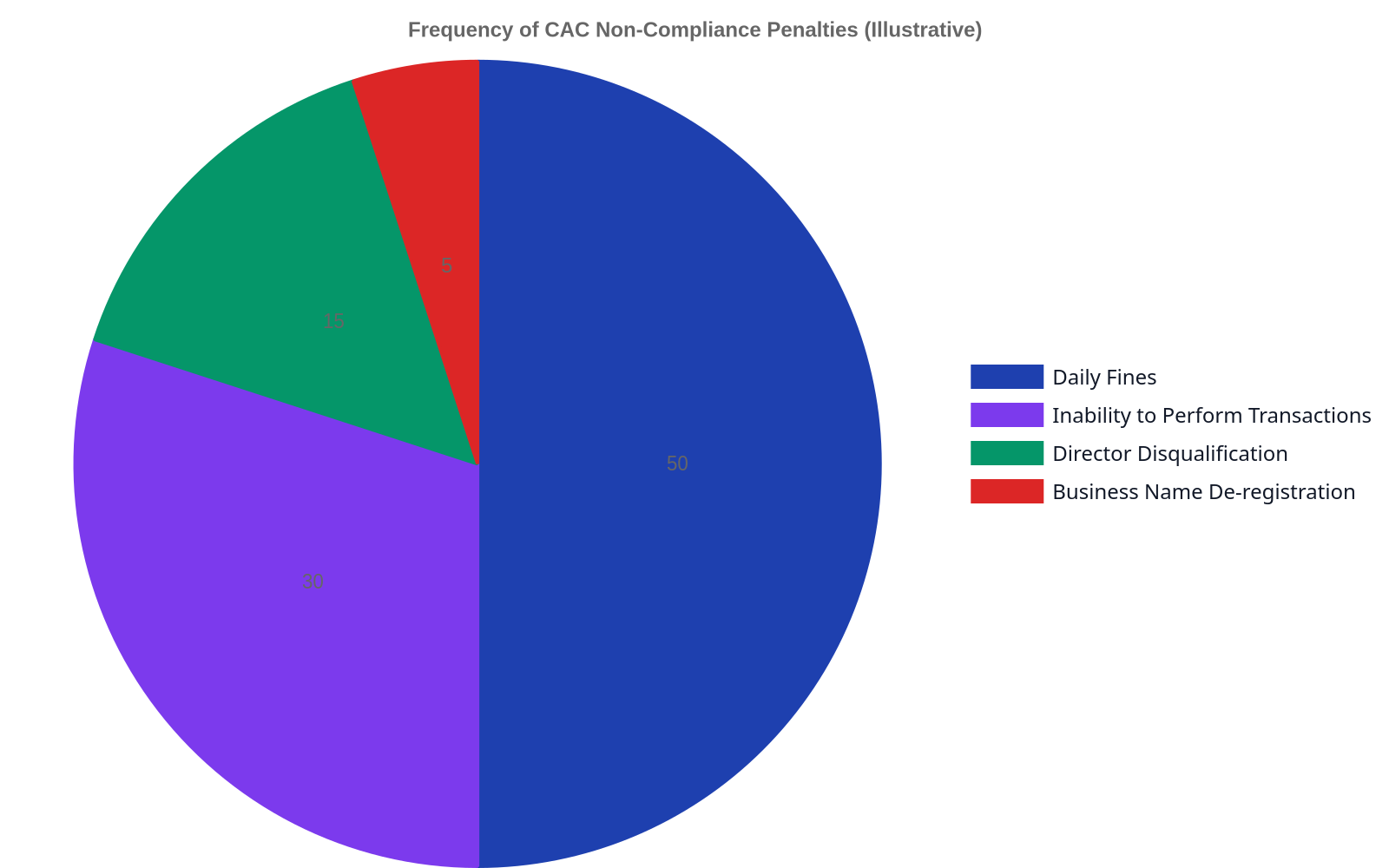
Understanding the consequences of failure is a powerful motivator for compliance. The penalties for not filing your CAC annual returns in Nigeria are not just financial; they are operational. Under CAMA, the primary penalty is a daily fine for every day the default continues. As of late 2023, these fees can accumulate quickly, turning a small oversight into a significant liability.
However, the most severe penalty is being struck off the companies register. The CAC has the power to assume a company is no longer in business if it fails to file returns for a consecutive number of years (typically 10). Maintaining good standing on the corporate registry is fundamental for accessing credit and investment. Once your company is struck off, it legally ceases to exist and cannot operate its bank accounts, enter contracts, or conduct business. Restoring the company is a much more expensive and time-consuming process than filing on time.

5. Timeline and Filing Deadlines
Knowing When To file is as crucial as knowing What To file. 2020, a company must file its annual returns within 42 days after its Annual General Meeting (AGM). For a new company, the first AGM must be held within 18 months of incorporation. Subsequent AGMs must be held every calendar year, with no more than 15 months between them.
This creates a clear timeline. For an existing company, if your financial year ends on December 31st, you typically have until June 30th of the following year to hold your AGM. Following that, you have 42 days to file the returns with the CAC. This means most companies should aim to file by mid-August.
Your advisor should be able to help you map out these dates based on your incorporation date and financial year-end. Proactive management of this timeline is a hallmark of good corporate governance. We often advise Nigerian and foreign investors to establish a compliance calendar from day one to avoid missing these critical deadlines.
Don’t think of the annual return as a single event. See it as the final step in a year-long cycle of proper record-keeping and financial management.
Questions to Ask Before You Commit to a Service Provider
Before you hire a lawyer, accountant, or filing service to handle your annual returns, ask these specific questions:
- Which specific section of CAMA 2020 mandates annual returns?
- Based on my company’s incorporation date, do I need to submit audited financials or a Statement of Affairs?
- What are the current daily penalty rates for late filing?
- Can you provide a clear breakdown of your professional fees versus the statutory CAC filing fees?
- What is your process for reviewing my financial statements for compliance before submission?
- How long will the entire process take, from receiving my documents to getting the CAC acknowledgement?
- What documents, specifically, do you need from me to begin?
- Will I receive an official acknowledgement of filing from the CAC portal?
- What happens if the CAC rejects the filing for any reason? Is the correction included in your fee?
- How do you handle the filing of alterations if my company details (directors, address) have changed since the last return?
Red Flags to Watch For
- Guarantees of “no audit needed”: Unless your company is less than 18 months old, this is a major red flag.
- Vague pricing: A professional service should be able to clearly separate their fees from the government’s statutory fees.
- Lack of digital process: The CAC has moved its services online. A provider still insisting on a purely manual and opaque process is likely inefficient.
- No mention of CAMA: Any discussion of annual returns that doesn’t reference the governing law is unprofessional.
- Slow communication: This is a time-sensitive filing. An unresponsive agent is a liability.
A Simple Decision Framework
To ensure you are on the right track, use this simple weighting system for your compliance strategy:
- If your priority is cost-saving (as a new startup): Weight Criterion #3 (Statement of Affairs) the highest. Confirm your eligibility to avoid an unnecessary audit.
- If your priority is long-term compliance and risk avoidance: Weight Criterion #2 (Audited Financials) and Criterion #4 (Penalties) the hardest. The cost of a proper audit is far less than the cost of penalties or being struck off.
- If you are a foreign investor or a large corporation: Weight Criterion #1 (Legal Mandate) and #5 (Timeline) most heavily. Demonstrating a clear understanding of Nigerian law and proactive timeline management is key to satisfying shareholders and boards.
Ultimately, choosing to comply isn’t the question. The real decision is how to comply efficiently and correctly. For most businesses, this means engaging professionals who understand the nuances of the CAC’s requirements and the specific provisions of CAMA 2020.
FAQ
What are CAC annual returns?
CAC annual returns are a mandatory yearly report that every registered company in Nigeria must file with the Corporate Affairs Commission (CAC). The report contains details about the company’s directors, shareholders, registered address, and financial health, confirming that the company is still an active business concern.
Who is required to file annual returns in Nigeria?
Every company incorporated in Nigeria, including private limited companies, public limited companies, and companies limited by guarantee, must file annual returns every year. The only exception is in the first year of incorporation; the first filing is due after the company holds its first Annual General Meeting (AGM).
What is the deadline for filing CAC annual returns?
According to the Companies and Allied Matters Act 2020, a company must file its annual returns within 42 days of its Annual General Meeting (AGM). An AGM must be held once every calendar year.
What happens if I don’t file my annual returns?
Failure to file annual returns incurs a daily penalty for every day of default. More critically, the CAC can presume the company is no longer in operation and may strike its name from the official register, causing the company to legally cease to exist.
Can I file CAC annual returns myself?
The CAC has an online portal that allows for self-filing. However, the process requires specific documentation, most notably audited financial statements prepared by a certified auditor. Due to these complexities, most businesses, including public and private companies, choose to use a CAC-accredited agent like a law firm or accounting firm to ensure the filing is done correctly.
What is the difference between an annual return and a tax return?
An annual return is filed with the Corporate Affairs Commission (CAC) to report on a company’s corporate structure and status. A tax return is filed with the Federal Inland Revenue Service (FIRS) to report a company’s income and calculate its tax liability. They are two separate legal obligations.
At Ardnas Legal, we specialize in helping businesses navigate their corporate compliance obligations smoothly. If you have questions about filing your CAC annual returns in Nigeria or need assistance ensuring your company is in good standing, contact our team for a consultation.
Related reading
- 7 Steps to Trademark Registration in Nigeria
- Trademark vs. Copyright in Nigeria: Which IP Is Right for You?.
About the author

Sandra Adeniran
Principal Partner
Adebola Adeniran is the Founding Partner of Ardnas Legal Practitioners. She is a dynamic and forward-thinking lawyer with a passion for providing innovative legal solutions to businesses and individuals. Adebola combines deep legal expertise with a practical, business-oriented approach, ensuring that clients receive advice that is both strategic and actionable.