
Production Sharing Contract Nigeria: A Deep Dive for 2026
Think of oil exploration as the world’s most expensive treasure hunt. The map is seismic data, the treasure is buried thousands of metres below the seabed, and the cost of the expedition runs into hundreds of millions, or even billions, of dollars with absolutely no guarantee of success. Who should bet the farm on such a venture? The government, which owns the resource, or a specialized company with the capital and technology to find it? This is the fundamental question that a Production Sharing Contract (PSC) answers.
A production sharing contract in Nigeria is a legal agreement between an oil and gas company (contractor) and the Nigerian National Petroleum Company Limited (NNPC Ltd.). Under a PSC, the contractor funds and executes all exploration and production activities at its own risk. If successful, the contractor recovers its costs from a portion of the produced oil and shares the remaining ‘profit oil’ with the government. This model, heavily reshaped by the Petroleum Industry Act 2021, is the dominant fiscal arrangement for Nigeria’s deep-water operations.
What is a Production Sharing Contract (PSC)?
At its core, a PSC is an arrangement where the state, as the owner of mineral resources, engages a contractor (typically an International Oil Company or IOC) to provide technical expertise and financial capital for exploration and production. Unlike a concession where a company pays for the right to find and own the petroleum, under a PSC, the state retains ownership of the resources throughout the process. The contractor is entitled to a share of the production as compensation for its risk and a reward for its efforts.
Core Definition and Purpose
The primary purpose of the PSC model is to attract foreign investment and technical skill for high-risk exploration projects, particularly in deep-water offshore areas where the costs and technological challenges are immense. By placing the exploration risk entirely on the contractor, the government avoids spending its own funds on unsuccessful ventures. The contractor bears the full financial brunt of drilling a dry hole.
If oil is discovered and produced, the contractor is first allowed to recoup its capital and operating expenditures. This is done by allocating a certain percentage of the monthly production to the contractor, a volume known as “Cost Oil.” What remains after this cost recovery is “Profit Oil,” which is then split between the government (via NNPC Ltd.) and the contractor according to a pre-negotiated ratio.
The Parties Involved
Several key entities are central to any production sharing contract in Nigeria:
- The Federal Government of Nigeria: Represented by the Minister of Petroleum, it holds the ultimate authority and ownership of all petroleum resources in the country.
- Nigerian National Petroleum Company Limited (NNPC Ltd.): Since the PIA 2021, the NNPC has transitioned from a state corporation to a commercial limited liability company. It is the party that enters into the PSC with the contractors, representing the government’s commercial interests.
- The Contractor (IOCs/Independents): This is the oil company or consortium that signs the PSC. It provides 100% of the funding for exploration, development, and production operations.
- Nigerian Upstream Petroleum Regulatory Commission (NUPRC): Established by the PIA 2021, the NUPRC is the primary regulator for all upstream petroleum operations, including technical and commercial oversight of PSCs. It ensures compliance with the terms of the contract and the governing laws.
History and Evolution of PSCs in Nigeria
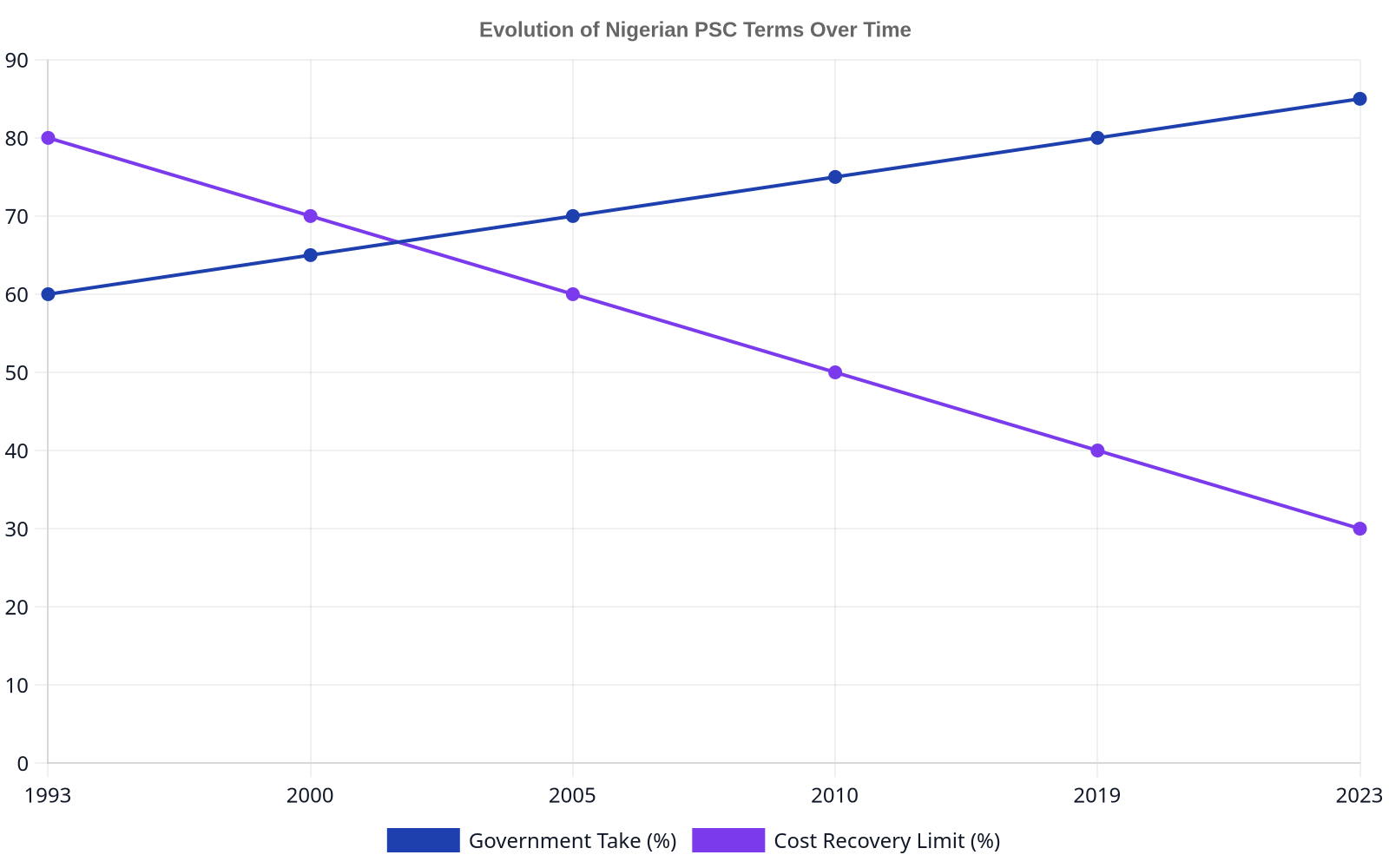
The contractual frameworks governing Nigeria’s oil and gas sector have not been static. They have evolved in response to global oil prices, technological advancements, and the country’s changing economic and political priorities. Our firm’s Oil & Gas Practice provides legal support to companies navigating these complex agreements.
The Pre-PSC Era: Concessions and Joint Ventures
Initially, the Nigerian oil industry operated on a system of concessions, where oil majors were granted broad rights over large acreages for a fixed period. The government’s primary take was through royalties and taxes. In the 1970s, Nigeria shifted towards Joint Ventures (JVs), where the state-owned NNPC held a majority equity stake (typically 55-60%) in operations with IOCs. While this gave the government more direct involvement, it also came with a significant burden: the NNPC was required to contribute its share of cash calls for operating and capital costs, which often strained government finances.
The First PSCs (1993 and Beyond)
To open up the capital-intensive deep-offshore frontier without incurring massive debt, Nigeria introduced its first PSCs in 1993. This model was a revelation; it shifted the financing risk for exploration entirely to the IOCs. The government would not have to pay a single dollar in cash calls. In return for taking on 100% of the exploration risk, contractors received a mechanism to recover their costs and a share of the profits if the venture was successful. This policy decision was directly responsible for unlocking Nigeria’s vast deep-water reserves.
The Impact of the Petroleum Industry Act (PIA) 2021
The most significant change in the history of Nigerian petroleum law arrived with the Petroleum Industry Act (PIA) in 2021. This landmark legislation overhauled the entire legal, regulatory, and fiscal landscape. For PSCs, the PIA introduced a new fiscal framework, mandated the conversion of existing leases to new terms, and created new regulatory bodies. Any PSC operating in Nigeria today must be understood through the lens of the PIA, as its provisions supersede many terms of the older contracts.
How Production Sharing Contracts (PSCs) Work in Nigeria
The lifecycle of a PSC follows a logical sequence from exploration to the sharing of proceeds. Understanding this flow is key to grasping the commercial drivers of the agreement.
- Exploration Phase: The contractor is granted exclusive rights to explore a defined contract area for a specified period (e.g., up to 10 years for deep-water blocks under the PIA). During this time, the contractor must meet a Minimum Work Obligation, which could include acquiring seismic data and drilling a certain number of exploration wells. All costs are borne by the contractor.
- Development & Production Phase: Upon a commercial discovery, the contractor submits a Field Development Plan (FDP) to the NUPRC for approval. Once approved, it proceeds to develop the field and commence production, again, funding 100% of the development costs, which can exceed a billion dollars for a major deep-water project.
- Cost Recovery (“Cost Oil”): Once production begins, the contractor is entitled to recover its accumulated capital and ongoing operational costs. A specified percentage of the gross production is set aside as “Cost Oil” for this purpose. The PIA sets limits on the amount of production that can be used for cost recovery in any given year, ensuring the government receives revenue early.
- Tax Oil Allocation: A portion of the remaining oil, known as “Tax Oil,” is allocated to cover the contractor’s tax obligations, primarily Petroleum Profit Tax (PPT) and, under the PIA, Hydrocarbon Tax (HT).
- Profit Oil Split: The final volume of crude remaining after Cost Oil and Tax Oil are deducted is the “Profit Oil.” This is the core of the reward mechanism and is split between NNPC Ltd. and the contractor based on a sliding scale, often tied to production volumes or the contractor’s rate of return.
A PSC isn’t just a financial agreement; it’s a risk allocation instrument. The party best able to bear the geological and financial risk—the IOC—takes it on, in exchange for a share of the potential reward.
Key Components of a Nigerian PSC
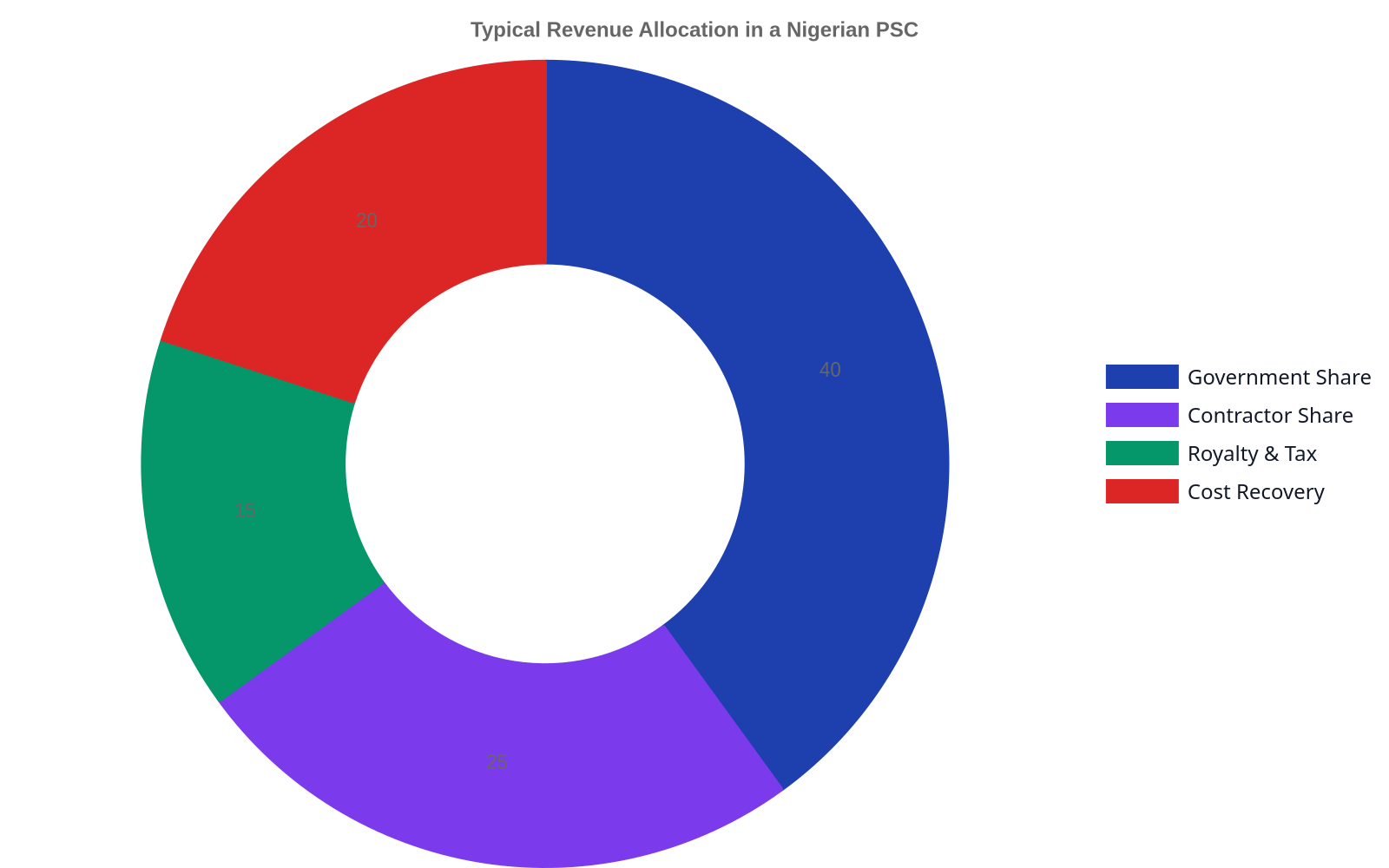
While each PSC is a unique negotiation, they are all built around a common set of components governed by the PIA.
The Exploration Period and Minimum Work Obligations
This section defines the duration the contractor has to explore for petroleum. The contract will specify the minimum amount of investment and activity (e.g., 2D/3D seismic acquisition, number of wells) the contractor must complete to retain the license. Failure to meet these obligations can lead to forfeiture of the block.
Fiscal Terms: Royalty, Tax, and Profit Split
This is the financial heart of the contract. The key elements, as defined by the PIA, include:
- Royalty: This is a payment made to the government based on the volume of production. The PIA introduced a dual royalty system: a royalty by price (based on oil price) and a royalty by production. For new PSCs, rates vary from 15% for onshore areas to 7.5% in deep offshore zones (>200m water depth).
- Taxes: Contractors under PSCs are subject to Company Income Tax (CIT) at 30% and, for onshore and shallow water, a Hydrocarbon Tax (HT). The structure of these taxes is a critical change introduced by the PIA.
- Profit Oil Split: This is the negotiated percentage share of profit oil between NNPC Ltd. and the contractor. It is often designed on a sliding scale, where the government’s share increases as production levels rise or as the contractor achieves a higher rate of return.
Gas Development and Monetization Clauses
Historically, natural gas was an afterthought. The PIA 2021 changes this dramatically, introducing specific fiscal terms for natural gas to encourage its development. PSCs now have detailed provisions governing the rights and obligations of the contractor regarding the exploration and monetization of natural gas, which is treated separately from crude oil.
Comparison with Other Fiscal Regimes
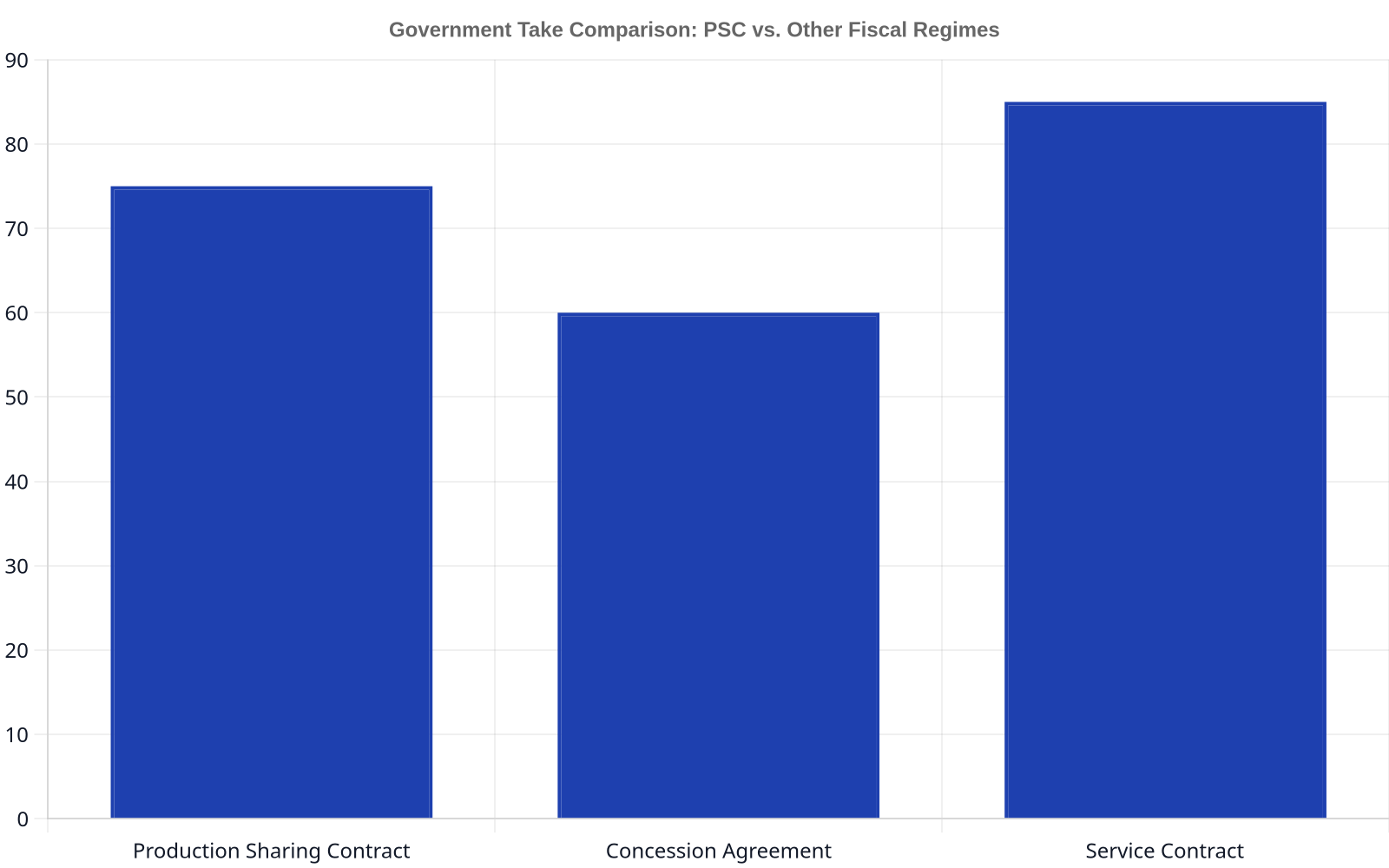
The PSC is just one of several types of agreements used in the Nigerian oil and gas industry. Comparing it with others clarifies its unique characteristics.
| Feature | Production Sharing Contract (PSC) | Joint Venture (JV) | Service Contract |
|---|---|---|---|
| Risk Bearing | 100% Contractor Risk | Shared between NNPC and IOC based on equity | 100% Government/NNPC Risk |
| Funding | 100% Contractor funded | Funded by all parties via cash calls | Government/NNPC pays contractor a fee |
| Ownership of Petroleum | NNPC Ltd. owns petroleum until export point | Title is transferred to parties at the wellhead | Government/NNPC retains title always |
| Cost Recovery | Directly from a portion of crude (“Cost Oil”) | Costs are deducted before profits are shared | Contractor paid a fee; no direct cost recovery |
| Primary Use Case | Deep-water and high-risk frontiers | Onshore and shallow water (historically) | Used for specific, low-risk technical services |
|---|
As the table shows, the primary distinctions lie in who funds the operation and who bears the risk of failure. The PSC model’s popularity in deep-water exploration stems directly from its effectiveness in transferring this risk away from the state.
The Role of the Petroleum Industry Act (PIA) 2021
It is impossible to discuss any modern production sharing contract in Nigeria without focusing on the PIA. It represents a fundamental shift.
The PIA 2021 didn’t just tweak the old system; it created an entirely new one. For any production sharing contract in Nigeria, understanding the pre-PIA and post-PIA distinction is the absolute starting point.
Conversion of Existing Leases
The PIA mandates that holders of existing Oil Mining Leases (OMLs) must convert them to new Petroleum Mining Leases (PMLs) to benefit from the new fiscal terms. This conversion process is not automatic; it requires negotiation and agreement, effectively rebasing old PSCs under the new legal framework. As one of the leading law firms in Nigeria, we have advised both international and domestic clients on the nuances of this critical conversion process.
New Fiscal Framework under the PIA
The PIA scraps the old Petroleum Profit Tax for new contracts, replacing it with a combination of Hydrocarbon Tax (HT) and Companies Income Tax (CIT). According to analysis from the Nigeria Extractive Industries Transparency Initiative (NEITI), this is intended to provide clarity and attract new investment. Royalties are no longer fixed but vary based on production levels, terrain, and oil price, creating a more responsive system.
Host Community Development Trust
A major social and legal innovation of the PIA is the creation of the Host Communities Development Trust (HCDT). Settlors of PSCs are now required to contribute 3% of their actual annual operating expenditure into a trust fund for the development of the host communities where they operate. This is a direct, legally mandated obligation intended to create a more stable and beneficial relationship between operators and communities, a departure from previous ad-hoc arrangements.
Legal and Commercial Challenges in Nigerian PSCs
Despite the improved clarity from the PIA, challenges remain inherent in these long-term, high-value contracts.
Dispute Resolution Mechanisms
Given the involvement of international parties, most modern PSCs contain clauses that specify international arbitration (e.g., under ICC rules in London or Paris) as the mechanism for resolving disputes. This is often preferred by IOCs who seek a neutral forum. However, the jurisdiction of Nigerian courts remains a complex and sometimes contentious issue, particularly regarding regulatory matters.
Cost Recovery Audits and Disputes
A frequent source of friction is the audit of the contractor’s recoverable costs by NNPC Ltd. and the NUPRC. Disputes can arise over whether certain expenditures are legitimately part of petroleum operations and therefore recoverable. These disputes can lock up significant funds and require extensive negotiation or arbitration to resolve. Expert legal analysis highlights the technical and financial complexity of these cost recovery disputes.
Regulatory and Political Stability
While the PIA 2021 aims to provide a stable and predictable legal framework for the next few decades, the oil and gas industry is always subject to political and regulatory shifts. Investors and contractors must continuously monitor the implementation of the PIA and any subsequent amendments or regulations from the NUPRC to ensure ongoing compliance and to anticipate future changes in the investment climate.
Navigating the intricacies of a production sharing contract in Nigeria requires deep legal expertise and a practical understanding of the industry. These are not standard commercial agreements; they are complex instruments of national economic policy, risk management, and multi-billion dollar investment. Getting the structure and negotiation right is paramount.
FAQ
What is the main difference between a PSC and a Joint Venture in Nigeria?
The primary difference is funding and risk. In a PSC, the contractor funds 100% of the operations and bears all the risk. In a JV, the NNPC and the IOC partners contribute funds according to their equity shares and share the risk proportionally.
Who owns the oil in a Production Sharing Contract?
The Federal Government of Nigeria, through NNPC Ltd., legally owns the petroleum throughout the production process. The contractor is entitled to a share of that production as payment for its services and risk but does not own the resource in the ground.
How did the Petroleum Industry Act (PIA) 2021 change PSCs?
The PIA fundamentally changed PSCs by introducing a new fiscal regime (new royalties and taxes), creating new regulatory bodies (NUPRC and NMDPRA), mandating the conversion of old leases, and establishing the Host Community Development Trust, which requires a 3% opex contribution.
What is “Cost Oil” and “Profit Oil”?
“Cost Oil” is the portion of crude oil production that the contractor is allowed to take to recover its capital and operating costs. “Profit Oil” is the remaining volume of crude after Cost Oil is deducted, which is then split between the government (NNPC Ltd.) and the contractor.
Can foreign companies fully own an oil and gas operation under a PSC?
No. Under a PSC, the foreign company acts as a contractor for NNPC Ltd. and does not own the asset or the petroleum reserves. It has a contractual entitlement to a share of the production, but ownership of the underlying license and resource remains with the Nigerian state.
Crafting, negotiating, and operating under a Production Sharing Contract in Nigeria is a complex undertaking with significant financial and legal implications. Whether you are an existing operator navigating the PIA conversion or a new investor considering entry, securing expert legal guidance is not just advisable—it is essential. If your company needs advice on navigating Nigeria’s upstream sector, contact our legal team today.
About the author

Sandra Adeniran
Principal Partner
Adebola Adeniran is the Founding Partner of Ardnas Legal Practitioners. She is a dynamic and forward-thinking lawyer with a passion for providing innovative legal solutions to businesses and individuals. Adebola combines deep legal expertise with a practical, business-oriented approach, ensuring that clients receive advice that is both strategic and actionable.